
When your systems can't see the big picture – build your own layer on top
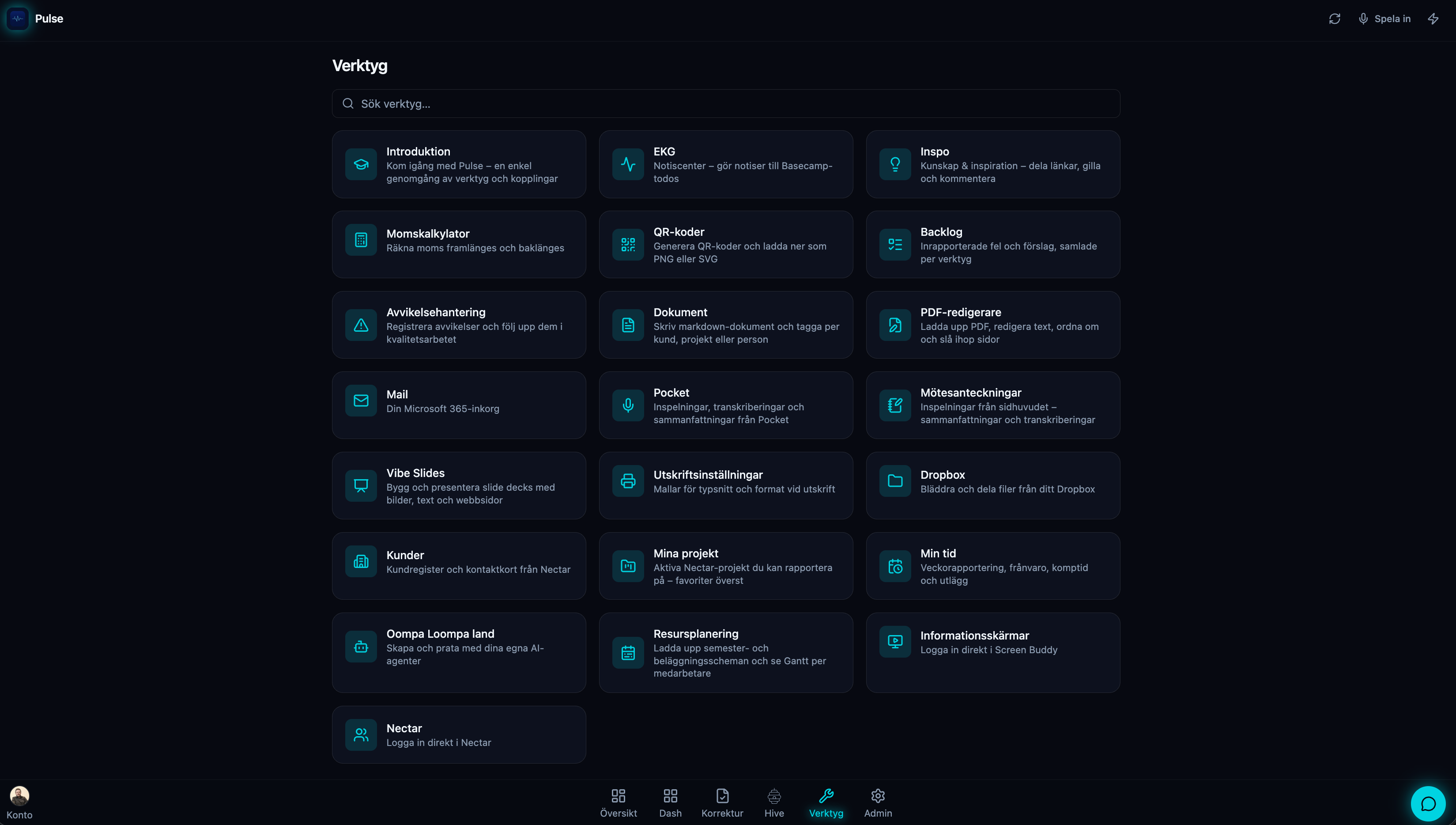
Our information was spread across systems for accounting, time reporting and project management – they shared some data, but far from all of it, and none of them had AI. With Pulse and Nectar we bring the information together, automate recurring tasks and let AI analyse data from several systems at once.
Most companies already have more systems than they really want.
We're no exception.
Among other things, we have one system for accounting, one for time reporting and one for project management. They're good at different things, and some information is synced between them.
The only problem is that none of them sees the whole picture.
TL;DR
Our information was spread across systems for accounting, time reporting and project management – they shared some data, but far from all of it, and none of them had AI. With Pulse and Nectar we bring the information together, automate recurring tasks and let AI analyse data from several systems at once.
One place where the information meets
Information lives in different places. Some data has to be entered more than once. And when we want to combine information from several systems to understand a customer, keep track of finances or analyse the business, it quickly becomes needlessly cumbersome.
On top of that, an important piece of the puzzle is missing: AI.
So instead of replacing our existing systems, we started building our own layer on top of them.
The result was Pulse and Nectar.
They have different focuses. One is more about customers, documentation and day-to-day work, while the other focuses more on finances, deals and numbers.
But the big win is that they can pull information from our other systems and combine it.
That also means we can use AI to analyse data that used to be spread across many different places.
Instead of asking a single system, we can let the AI work with the whole picture.
Small problems that add up to a lot of time
When we started building, we also realised how many small tasks come back every week and every month.
So Pulse and Nectar have gradually gained more features.
For example, we can record meetings directly in the system and have them automatically transcribed and summarised into meeting notes.
We can gather customer information from several sources and get one shared view of the customer.
We've built features for reconciling customer-related costs and making sure they actually get invoiced onwards.
Another module helps us with bookkeeping for card purchases and recurring software licences. The system keeps track of the supplier, receipts and, for example, whether the purchase was made inside or outside the EU. When everything is ready, the information and receipts can be passed on to the accounting system.
A job that used to take several hours every month has become much simpler.
From Excel lists to automated flows
We also host recurring events and breakfast meetups. That used to mean Excel lists being passed around and updated in different places.
Now everything lives in a shared event module.
We can see who's invited, who invited them, who has accepted or declined, the number of attendees and any dietary requirements.
Even the contact with the caterer is automated. Before the event, the caterer receives a compiled email with the number of attendees and anything that needs to be taken into account.
CRM, deals and invoicing in the same flow
In Nectar we can also manage prospects and deals through the different stages of the sales process.
When a deal is won, the process doesn't have to start over in the next system. For example, we can set up recurring invoicing right away and let the information sync on to the accounting system.
Then there are the really small things.
A VAT calculator. A simple image editor for quickly cropping a picture without opening Photoshop. A tool for checking domains and name servers.
On their own, none of them are revolutionary innovations.
But every time we avoid opening yet another program, moving information by hand or doing the same thing in two places, we save a little time.
And together, it adds up to a lot.
AI changes what's economically possible to build
Perhaps the most interesting thing about Pulse and Nectar isn't really the systems themselves.
It's that we were able to build them at all.
A few years ago, a tailor-made internal system with this many integrations and features would have required far more traditional development – and therefore a completely different investment.
With AI as part of the development process, the threshold has become much lower.
That doesn't mean every system is suddenly easy to build. Integrations, data structures, security and business logic can still be complex.
But the math has changed.
Things that might never have been economically justifiable to custom-build before can be perfectly reasonable today.
And we think that's one of the most exciting opportunities with AI right now.
Not just adding AI on top of the systems we already use.
But actually being able to build the tools that fit the business – instead of constantly adapting the business to the tools.